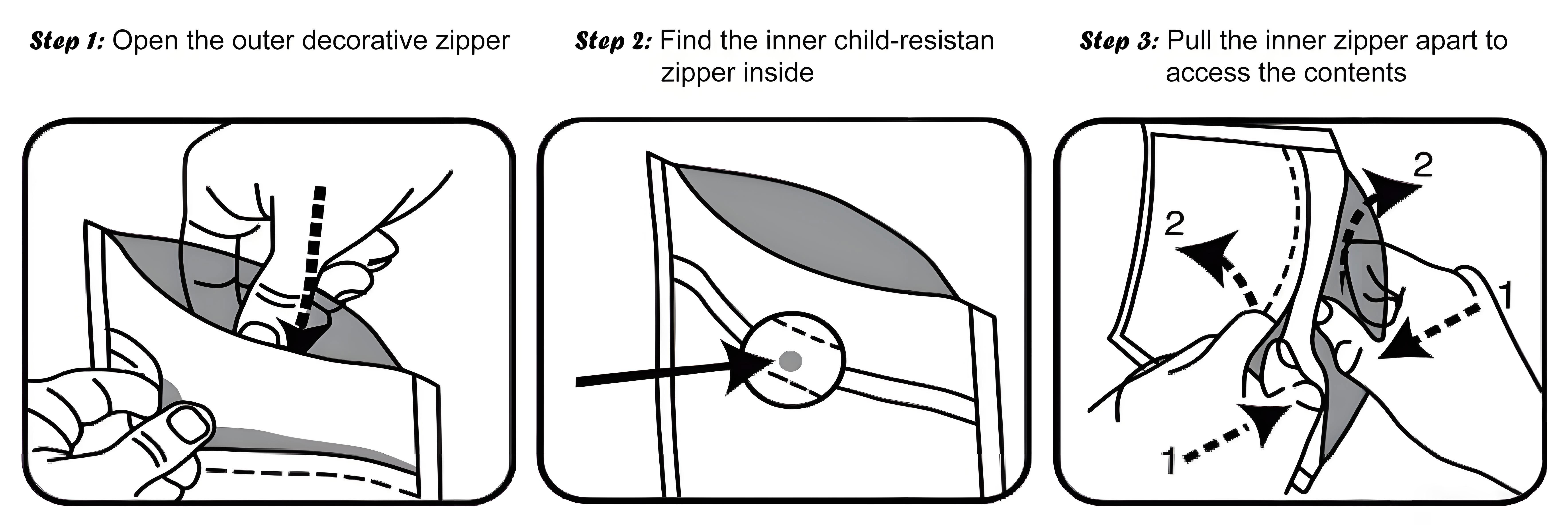
Packaging Knowledge Center · Child Resistant Packaging (CR) Child resistant (CR) packaging helps reduce accidental access to regulated cannabis products by children while remaining usable for adults. CR design is not just a “hard-to-open” closure — it’s a mechanism + test protocol + compliant production execution. This guide explains how CR packaging works, the most common mechanisms, and how testing & compliance are typically approached for U.S. markets. You’ll learn CR vs tamper-evident, common mechanisms, testing panels, and what “compliance” means in real production. Best for Brands comparing press-and-slide, squeeze-and-open, push-and-turn and multi-step closures. Related hub Browse CR formats: Child Resistant Packaging Overview Visual overview: common CR mechanisms used across pre-roll, vape, and edible packaging formats. Child resistant packaging is designed to require a combination of actions, strength, coordination, or understanding that is difficult for young children but reasonably manageable for adults. Effective CR designs don’t rely on “tightness” alone — they use intentional multi-step behaviors that reduce the chance of accidental or exploratory opening. In regulated cannabis markets, CR requirements typically apply to the outer packaging rather than the product itself. For a category-level overview across formats, see our child resistant packaging overview. Different packaging formats use different CR mechanisms depending on material, size, intended use, and the consumer opening experience. Below are the most widely adopted mechanisms for cannabis packaging formats. Users must apply pressure at a defined point while sliding a tray or panel in a specific direction. This dual-action movement is difficult to perform randomly, which helps reduce child access. Common uses: rigid paperboard drawer boxes for pre-roll packaging, vape cartridge packaging, and edibles (multi-pack cartons). Example: press-and-slide rigid drawer box with a dual-action lock commonly used for pre-rolls and vape cartridges. Users must squeeze specific points to release the lock while opening. Without knowing where and how to apply pressure, the package stays locked. Common uses: child resistant mylar bags and flexible pouch formats; also some paperboard tuck systems with hidden pinch zones. Example: CR mylar pouch using pinch points to unlock and open. Requires a sequence of actions (e.g., pushing while turning, aligning parts, or lifting and rotating) before opening. The sequence reduces accidental opening and discourages exploratory attempts by children. Common uses: plastic containers, jars, and certain child resistant tin packaging formats with engineered locking systems. Example: multi-step CR closure engineered for plastic containers, jars, and certain locking tin formats. Child resistant packaging is typically evaluated through standardized protocols that measure two things: whether children can open the package within a defined time window, and whether adults can open it without unreasonable difficulty. In practice, brands should treat CR testing as a combination of design validation + production consistency. CR testing method: typical child panel + adult panel evaluation workflow (conceptual illustration). Child panel: verifies children can’t open it within the test window Adult panel: verifies adults can open it without unreasonable difficulty Real-world validation: confirms the mechanism holds up during filling, shipping, and retail handling For U.S. markets, child resistant packaging is commonly evaluated under recognized safety frameworks such as 16 CFR §1700 (PPPA – Poison Prevention Packaging Act) and related format-appropriate test protocols. Many brands work with third-party test labs to validate that a specific structure and mechanism can meet the required benchmarks. Defines child test panel age range, time windows, and evaluation approach Requires adult usability verification (avoid “too hard to open” complaints) Highlights why manufacturing consistency matters as much as the mechanism concept Note: Exact requirements can vary by product category and target state rules. Brands should confirm local regulations and labeling rules. Test report example: documentation used to support CR compliance validation. Important: Passing a test supports that a design can meet recognized benchmarks, but compliance still depends on proper implementation in production, filling, and labeling. A small change in material stiffness, tolerance, or assembly can impact CR performance. Compliance involves more than selecting a closure type. Brands also need to consider labeling rules, packaging material selection, production efficiency, and cost — especially when SKUs expand. A “compliant design” must remain compliant at scale. Mechanism selection matches the product category and target market Adult usability is acceptable (avoid repeated complaints & returns) Labeling/warnings and required symbols have reserved space Structure can be filled efficiently without damaging the CR function Packaging can scale as SKUs grow (lead time + consistency) Material & tolerance control are documented (reduce variation between lots) If you’re building product-specific packaging systems, compare CR structures across categories: Vape Cartridge Packaging, Pre-Roll Packaging, and our CR Tin Packaging for popular locking formats. Selecting the appropriate CR mechanism depends on product type, target market, packaging format, and the opening experience you want. Evaluate adult usability, shelf presentation, and future SKU expansion early — changing mechanisms later can affect tooling, lead time, and compliance risk. No. Child resistant packaging is designed to restrict access. Tamper-evident features are designed to show whether a package was previously opened. Many regulated products use both for stronger safety and retail confidence. Most regulated markets require packaging to meet child resistant standards. Brands typically validate CR performance through recognized protocols and ensure the final produced packaging matches the tested configuration. CR mechanisms rely on controlled tolerances and material behavior. Changes in stiffness, thickness, assembly pressure, or locking geometry can change the force and sequence needed to open — which may impact real-world compliance and customer usability. Start with our Child Resistant Packaging Overview, then explore product hubs for vape cartridges and pre-rolls. If you want to browse CR formats by structure and material, start from our CR hub. If you need a recommendation for your product and market, send us your dimensions and target compliance requirements.
What Makes Packaging Child Resistant?
Child Resistant vs Tamper-Evident: What’s the Difference?
Common Child Resistant Packaging Mechanisms
1) Press-and-Slide (Button Lock / Dual Action Drawer)
2) Squeeze-and-Open (Pinch Points / Flex Lock)
3) Push-and-Turn / Multi-Step Closures (Sequence Opening)
How Child Resistant Packaging Is Tested (What “Compliance” Really Means)
Typical Test Panels
Testing Standards (U.S. Market Reference)
Compliance Considerations for Cannabis Brands
Quick compliance checklist
Choosing the Right Child Resistant Mechanism
FAQ: Child Resistant Packaging
Is child resistant packaging the same as tamper-evident?
Do cannabis brands need CR certification?
Why do “small production changes” matter for CR performance?
Where can I browse compliant CR formats by product type?
Next Steps