Ordering custom cannabis packaging is an important step for any cannabis brand. The right packaging can improve product presentation, protect the product and support long-term brand growth.
However, many brands make packaging decisions too quickly. They focus only on the unit price, choose a structure that does not fit the product or invest in large quantities before understanding their actual market demand.
Discussions among cannabis entrepreneurs often show the same concerns: What is the realistic MOQ? Should we start with printed bags or fully custom packaging? Do we need child-resistant packaging? How can we avoid wasting money on packaging inventory?
Before placing an order, asking the right questions can help brands avoid expensive mistakes and choose a packaging solution that matches their current stage.

Different packaging strategies fit different stages of cannabis brand development.
The first question brands should answer is not “How much does packaging cost?” but “What exactly are we packaging?”
Cannabis packaging requirements vary significantly depending on the product. Flower, pre-rolls, edibles, concentrates and vape products all have different protection needs.
For example:
Flower packaging needs odor control, moisture protection and suitable storage conditions.
Pre-roll packaging needs protection against crushing and accurate sizing for different cone lengths.
Edible packaging needs additional attention to child-resistant requirements and product safety.
Vape cartridge packaging requires precise dimensions and protection for fragile components.
Before requesting a quote, brands should prepare basic information such as product type, package size, quantity per package and target market.
Many new brands start by choosing a packaging material first. A better approach is to choose a packaging format based on the product and business goal.
Common options include:
| Product | Common Packaging Options |
| Flower | Mylar bags, glass jars |
| Pre-rolls | Paper boxes, tubes, tins |
| Edibles | Pouches, tins, paper boxes |
| Vape Cartridges | Paper boxes, tubes, display packaging |
The cheapest packaging is not always the most cost-effective choice. A package that does not protect the product or does not match the brand positioning can create additional costs later.
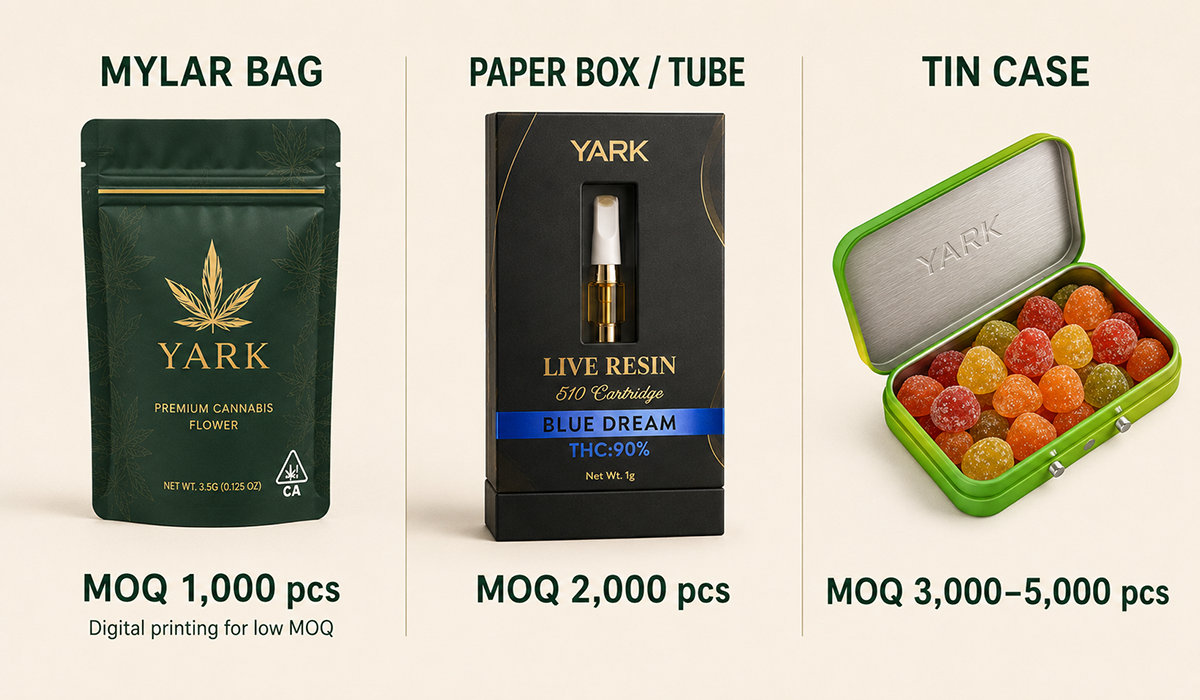
MOQ is one of the most common questions from new cannabis brands. Many companies want fully customized packaging but also hope to start with only a few hundred pieces.
The realistic MOQ depends heavily on the packaging structure, production process and printing method.
For custom paper boxes and paper tubes, a typical starting quantity is around 2,000 pieces.
Paper packaging requires material preparation, printing setup and production adjustment. Ordering too few pieces can make the unit cost much higher because the setup cost is spread across fewer units.
Custom printed mylar bags are also commonly produced around 2,000 pieces for standard production.
However, digital printing provides more flexibility for smaller launches. For brands testing a new product or launching limited quantities, digital printing can support orders around 1,000 pieces without the same printing setup requirements as traditional large-volume production.
This makes mylar bags a practical option for emerging brands that want custom artwork while controlling inventory risk.
Custom tin packaging usually requires a higher MOQ because of tooling, metal production processes and setup requirements.
A typical starting quantity is around 5,000 pieces, while larger quantities often provide better pricing efficiency.
For brands considering premium pre-roll or edible packaging, tins can provide stronger product protection and a more premium customer experience, but the investment should match the expected sales volume.
Child-resistant packaging is one of the most important factors cannabis brands need to confirm before starting production.
A common mistake is designing the packaging first and checking compliance requirements later. However, child-resistant requirements can affect the package structure, opening mechanism and material selection from the beginning.
The requirements may vary depending on:
Product category
Target market and regulations
Whether initial or reclosable child resistance is required
Packaging structure and testing requirements
For example, a child-resistant pouch, tin case and paper box may use completely different opening mechanisms.
Brands should confirm the requirement before finalizing the design. More information about child-resistant packaging can help brands understand the available structures and considerations.
A packaging design may look impressive on a computer screen, but not every design is practical for production.
Many problems happen when the design is created without considering manufacturing limitations.
Common issues include:
Too many complicated folding structures
Opening mechanisms that are difficult to produce consistently
Finishing effects that increase cost significantly
Inserts that are unnecessary or difficult to assemble
The best packaging projects usually involve the manufacturer early in the process. Structural feedback before production can prevent expensive redesigns later.
Before approving artwork, brands should confirm:
Final dimensions
Material thickness
Opening and closing method
Insert structure
Production process
One of the easiest ways to reduce unnecessary packaging cost is choosing the correct size from the beginning.
A small product does not always need a large package. Oversized packaging increases material usage, shipping volume and storage requirements without necessarily improving protection.
The packaging size should be based on:
Actual product dimensions
Product quantity per package
Required protection level
Retail presentation requirements
For example, a 5-pack pre-roll package should be designed around the actual cone size and insert structure instead of adding unnecessary empty space.
The same principle applies to flower bags, concentrate containers and vape packaging. The right size usually creates better cost efficiency and a better customer experience.
Many brands compare suppliers only by unit price. However, the lowest unit price does not always represent the lowest overall cost.
The real packaging investment may include:
Packaging unit cost
Sampling cost
Tooling or mold cost
Printing setup cost
Assembly requirements
Shipping cost
For example, a slightly higher unit price may still be more economical if it avoids expensive tooling or reduces shipping volume.
Brands should always evaluate the total landed cost instead of only comparing the factory price.
A digital design file cannot show every detail of the final packaging.
Physical samples allow brands to check:
Color accuracy
Material feeling
Printing quality
Opening experience
Overall product presentation
This is especially important for custom boxes, tins and premium packaging where structure and finishing strongly influence the final appearance.
Packaging production should be planned together with the product launch schedule.
Typical production timing depends on the structure:
| Packaging Type | Typical Production Time |
| Paper Box | Around 15 days |
| Mylar Bag | Around 20 days |
| Tin Case | Around 30 days |
Brands should also consider sampling time, artwork approval and shipping time when planning a launch.
Not every brand needs fully customized packaging from the first order.
The right approach depends on the brand stage.
Custom cannabis packaging is not only about manufacturing a box, bag or container. A reliable packaging partner should help brands make better decisions before production starts.
The right supplier should understand the relationship between product requirements, packaging structure, MOQ, compliance and future growth plans.
For example, a startup brand launching its first flower product may need a different solution from an established brand developing a premium limited-edition product.
A good packaging partner should help answer questions such as:
Is this packaging structure suitable for my product?
Can the MOQ match my current business stage?
Will the package meet the required child-resistant standard?
Can the design be manufactured efficiently?
Can this packaging support future product expansion?
Many new cannabis brands think low MOQ means they have to accept basic packaging. This is not necessarily true.
A smart low-MOQ strategy allows brands to control investment while still creating professional packaging.
For example:
Digital printed mylar bags can support smaller product launches
Custom paper boxes can provide strong branding flexibility
Stock packaging with labels can help test market response
Premium custom structures can be developed after sales volume becomes stable
The goal is not to order the most expensive packaging immediately. The goal is to choose the packaging that supports the brand at the right time.
At YARK, we work with cannabis brands at different stages, from new product launches to established packaging programs.
Instead of recommending the same packaging solution for every customer, we evaluate the product type, quantity, target market and brand positioning first.
Our team can help compare different options, including:
Printed mylar bags for flexible and efficient launches
Paper boxes and tubes for customized product presentation
Tin packaging for premium and reusable applications
Child-resistant structures for compliant cannabis products
Custom packaging development for brands ready to scale
For brands still comparing different packaging options, our cannabis packaging FAQs provide additional information about materials, structures, MOQ and production considerations.
Whether you need a small-batch launch solution or a long-term custom packaging program, choosing the right structure at the beginning can save time, cost and unnecessary inventory.
Share your product type, packaging requirements, target quantity and market plans. We can help evaluate suitable packaging structures based on your current business stage.
Find the right balance between MOQ, cost, packaging performance and brand presentation.
Contact YARKFor more information about cannabis packaging structures, compliance considerations and product solutions, visit our packaging resources.
| Brand Stage | Recommended Approach |
| New Brand / Testing Stage | Digital printed bags, labels or flexible packaging options |
| Growing Brand | Custom boxes, improved structures and stronger branding |
| Established Premium Brand | Custom tins, private molds and unique packaging development |